Amazon Fees Explained: Complete Seller Guide (2026)
Table of Contents
Amazon fees are confusing - and they can destroy your margins if you don’t understand them. This complete guide explains every Amazon fee type: referral fees, FBA fees, storage fees, closing fees, and hidden costs that catch sellers by surprise. We’ll show you exactly what Amazon charges and how to calculate if your products are profitable.
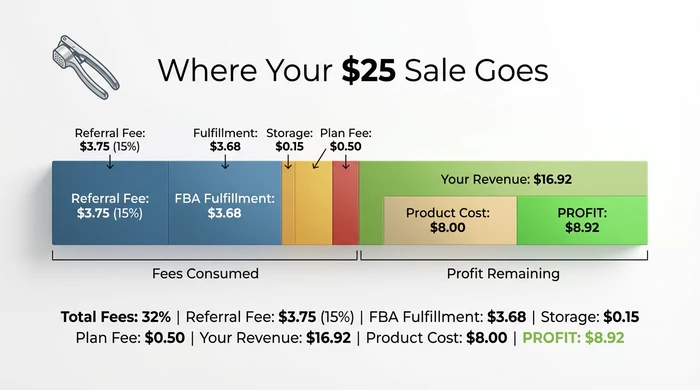
How a $25 Amazon sale breaks down into fees, revenue, and profit
How Much Does Amazon Take From Sellers?
Amazon typically takes 20-35% of your sale price in combined fees. The exact percentage depends on your product category, fulfillment method, and selling plan.
Here’s where that percentage comes from:
Referral fees (8-15%) are Amazon’s commission on every sale. This is the largest fee for most sellers. Amazon charges this regardless of whether you use their fulfillment services.
Selling plan fees add either $39.99 per month (Professional plan) or $0.99 per item sold (Individual plan). Professional sellers pay no per-item fee.
FBA fees apply if you use Fulfillment by Amazon. These include per-unit fulfillment costs plus monthly storage charges.
The “total cost” mindset matters here. Many sellers focus only on referral fees and underestimate their true costs. A product with a 15% referral fee doesn’t leave you 85% of the sale price. Storage, fulfillment, returns, and plan fees all take additional bites.
For a typical small product in the Home & Kitchen category selling for $25, total Amazon fees run approximately $8 per unit. That’s 32% of the sale price going to Amazon before you account for product cost or shipping to Amazon’s warehouses.
Referral Fees: Amazon’s Cut of Every Sale
Referral fees are percentage-based commissions Amazon charges on every sale. These fees are calculated on the total sale price, which includes the item price, shipping charges, and any gift wrap fees.
Most product categories carry a 15% referral fee. However, rates range from 8% for electronics and computers to 20% for jewelry. Some categories have variable rates based on price points.
| Product Category | Referral Fee % | Notes |
|---|---|---|
| Amazon Device Accessories | 45% | Highest fee category |
| Jewelry | 20% | 5% for items over $250 |
| Apparel (full price) | 17% | Reduced rates for items under $20 |
| Apparel (under $15) | 5% | Reduced January 2024 |
| Apparel ($15-$20) | 10% | Reduced January 2024 |
| Shoes, Handbags, Sunglasses | 15% | Standard rate |
| Home & Kitchen | 15% | Standard rate |
| Sports & Outdoors | 15% | Standard rate |
| Toys & Games | 15% | Standard rate |
| Beauty & Personal Care | 8% - 15% | 8% for items $10 or less |
| Consumer Electronics | 8% | Lower rate category |
| Computers | 8% | Lower rate category |
| Video Games & Consoles | 8% | Plus $1.80 closing fee |
| Books | 15% | Plus $1.80 closing fee |
| Music, DVD, Video | 15% | Plus $1.80 closing fee |
| Grocery & Gourmet | 8% - 15% | 8% for items $15 or less |
Amazon applies a minimum referral fee of $0.30 per unit. If your percentage-based fee calculates to less than $0.30, you pay the minimum instead.
Media items (books, DVDs, video games, music) carry an additional closing fee of $1.80 per unit. This applies on top of the referral fee, making media one of the more fee-heavy categories despite the seemingly reasonable 15% referral rate.
Selling Plan Fees: Individual vs Professional
Amazon offers two selling plans with different fee structures.
Individual Plan:
- No monthly subscription fee
- $0.99 charged per item sold
- Best for sellers moving fewer than 40 items per month
- Limited access to tools and some restricted categories
Professional Plan:
- $39.99 monthly flat fee
- No per-item selling fee
- Best for sellers moving 40+ items per month
- Full access to bulk listing tools, advertising, and all categories
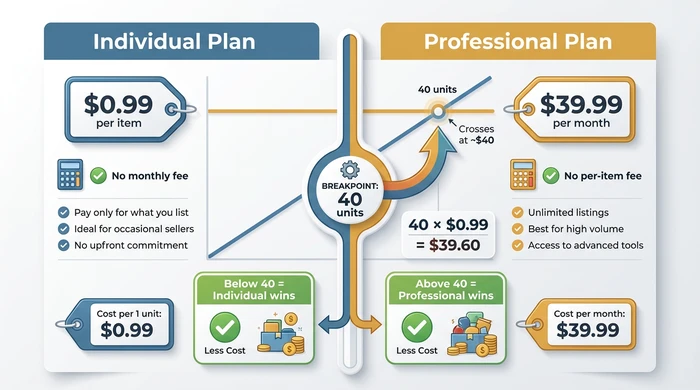
Individual vs Professional plan cost comparison with 40-unit breakpoint
The math for choosing between plans is straightforward. At 40 items sold per month, the Individual plan costs $39.60 (40 x $0.99). The Professional plan costs $39.99. They’re essentially equal at this threshold.
Sell fewer than 40 items monthly? Individual plan saves money. Sell more than 40 items? Professional plan is the clear choice.
Beyond the cost difference, Professional sellers gain access to the Buy Box, bulk listing tools, advertising capabilities, and categories that require approval.
FBA Fees: What Amazon Charges to Fulfill Your Orders
Fulfillment by Amazon (FBA) means Amazon stores your inventory, picks, packs, and ships orders, and handles customer service for those orders. This convenience comes with fees.
FBA Fulfillment Fees
FBA charges a per-unit fee to pick, pack, and ship each order. The fee depends on your product’s size tier and weight.
| Size Tier | Dimensions | Weight Range | Fulfillment Fee Range |
|---|---|---|---|
| Small Standard | 15" x 12" x 0.75" max | Up to 16 oz | $3.22 - $3.68 |
| Large Standard | 18" x 14" x 8" max | Up to 20 lb | $3.86 - $7.17 |
| Small Oversize | 60" x 30" max | Up to 70 lb | $9.73 - $15.68 |
| Medium Oversize | 108" max (length + girth) | Up to 150 lb | $19.79 - $43.53 |
| Large Oversize | 108" max, over 90 lb | Up to 150 lb | $89.98+ |
| Special Oversize | Over 108" or 150 lb | Over 150 lb | $158.49+ |
Small, lightweight products pay the lowest fulfillment fees. A typical small standard item under 16 ounces costs roughly $3.22-$3.68 per unit to fulfill. Heavier or larger products see fees increase substantially.
Storage Fees
Amazon charges monthly fees for inventory stored in their fulfillment centers. Rates depend on product size and the time of year.
Standard monthly storage:
- January through September: $0.78 per cubic foot
- October through December: $2.40 per cubic foot
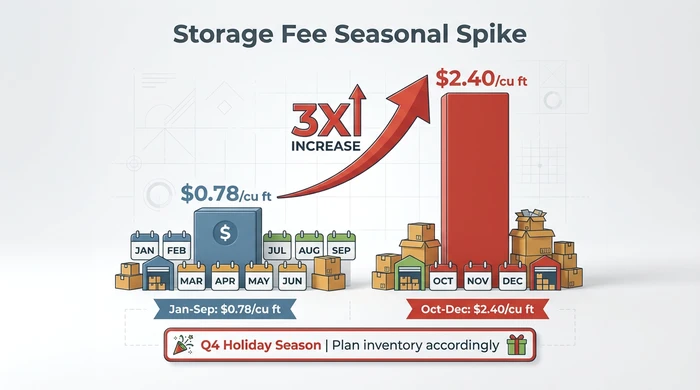
Q4 storage fees triple compared to the rest of the year
The Q4 spike catches many sellers off-guard. Storage fees triple during the holiday season. If you’re planning inventory for Q4, factor in this significant cost increase.
Aged Inventory Surcharges
Products sitting in Amazon’s warehouses too long trigger additional surcharges:
- 181-270 days: $1.50 per cubic foot surcharge
- 271-365 days: $3.80 per cubic foot surcharge
- Over 365 days: $6.90 per unit
These surcharges add on top of standard storage fees. Slow-moving inventory becomes increasingly expensive the longer it sits.
Inbound Placement Fees
When you send inventory to Amazon, they may charge inbound placement fees ranging from $0.27 to $1.58 per unit. These fees apply when Amazon distributes your inventory across multiple fulfillment centers for faster delivery.
You can reduce these fees by allowing Amazon to place inventory in a single location initially, though this may result in slower delivery times for customers in distant regions.
Hidden Fees That Catch Sellers Off-Guard
Beyond the core fees, several charges catch sellers by surprise.
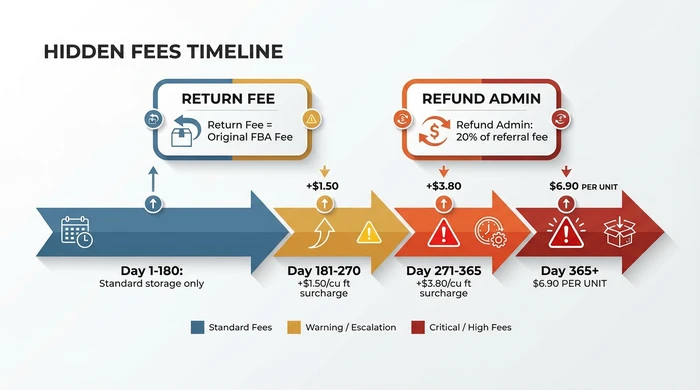
Hidden fees timeline: aged inventory surcharges and processing fees
Return Processing Fees
For products in categories eligible for free returns (apparel, shoes, accessories), Amazon charges a return processing fee equal to the original fulfillment fee. If a customer returns a $3.68 fulfillment item, you pay another $3.68 for Amazon to process that return.
High-return categories can see significant margin erosion from this fee alone.
Refund Administration Fee
When you refund a customer, Amazon keeps a portion of the referral fee you originally paid. They charge the lesser of $5 or 20% of the referral fee as an administrative charge.
On a $25 product with a $3.75 referral fee, Amazon keeps $0.75 when you issue a refund. On higher-priced items, the $5 cap provides some relief.
Removal and Disposal Fees
Need to get inventory out of Amazon’s warehouses? Removal fees range from $0.97 to $13.05 per unit depending on size. Disposal fees are slightly lower but still represent a cost for inventory you couldn’t sell.
High-Volume Listing Fees
Sellers with over 100,000 active listings pay $0.005 per listing beyond that threshold. This primarily affects large catalog sellers.
Calculate Your Total Amazon Fees
Understanding fee calculations before listing products prevents costly surprises. Here’s a framework for estimating your total Amazon costs.
Inputs:
- A = Sale Price (including shipping if applicable)
- B = Referral Fee % (by category)
- C = FBA Fulfillment Fee (based on size/weight)
- D = Selling Plan Fee Allocation
- E = Storage Fee Allocation
- F = Product Cost
Calculation:
- Referral Fee = A x B
- Net Revenue = A - Referral Fee - C - D - E
- Profit = Net Revenue - F
Break-Even Product Cost = Sale Price - Total Fees
Example Calculation
Consider a kitchen gadget selling for $25 in the Home & Kitchen category:
Fee breakdown:
- Sale Price: $25.00
- Referral Fee (15%): $3.75
- FBA Fulfillment (small standard, 12oz): $3.68
- Professional Plan allocation (80 units/month): $0.50
- Storage allocation: $0.15
Total fees: $8.08 (32.3% of sale price)
If your product cost is $8.00, your profit is $8.92 per unit. Your break-even product cost would be $16.92 - the maximum you can pay for the product and still make money.
Amazon provides a free Revenue Calculator in Seller Central. Use it to estimate fees for specific products before committing to inventory.
Should You Use FBA or FBM?
Fulfillment by Merchant (FBM) means you handle storage and shipping yourself. The choice between FBA and FBM significantly impacts your fee structure and operations.
| Your Situation | Recommended Action | Reasoning |
|---|---|---|
| Selling fewer than 40 items per month, testing the market | Individual Plan + FBM | Lowest cost entry. $0.99/item is cheaper than $39.99/month. FBM avoids storage fees while testing. |
| Selling 40+ items per month, can handle own fulfillment | Professional Plan + FBM | $39.99 flat fee saves money vs $0.99/item. FBM gives margin control and avoids FBA fees. |
| Selling 40+ items per month, want Prime badge and hands-off fulfillment | Professional Plan + FBA | Best combination for scaling. Prime badge increases conversions. Amazon handles logistics. |
| Selling oversized or heavy products | Professional Plan + FBM (usually) | FBA fees for oversized items are steep. Calculate both options - FBM often wins on margins. |
| Selling fast-moving, small, lightweight products | Professional Plan + FBA | Low FBA fees per unit. Fast turnover minimizes storage costs. Prime badge drives sales. |
| Seasonal products with uncertain demand | Professional Plan + FBM or Small FBA Test | Avoid Q4 storage fee spike and aged inventory surcharges. FBM keeps inventory flexible. |
| High-return category (apparel, shoes) | Professional Plan + Consider FBM | FBA return processing fees add up. FBM gives control over return handling and restocking. |
The Prime badge available through FBA typically increases conversion rates. Many customers filter searches by Prime-eligible products only. However, this benefit must be weighed against FBA’s additional costs.
For detailed guidance on optimizing your Amazon listings to maximize conversions regardless of fulfillment method, focus on your product titles, bullet points, and images.
Variations & Exceptions
International marketplace considerations: Fee structures vary by country. European marketplaces have different referral fee percentages and fulfillment costs. Research specific marketplace fees before expanding internationally.
FAQ
Q: What percentage does Amazon take from sellers?
Amazon takes 20-35% of your sale price through combined fees. Referral fees (8-15% depending on category) represent the largest component. FBA sellers pay additional fulfillment and storage fees that can add another 10-20% depending on product size and turnover rate.
Q: Is selling on Amazon worth it with all the fees?
Yes, for products with sufficient margins. The key is calculating total fees before sourcing. Many successful sellers maintain strong profitability by choosing products with at least 30% gross margin after all Amazon costs. Products with thin margins become difficult to sustain once fees, returns, and advertising costs are factored in.
Q: What are the hidden fees on Amazon FBA?
Watch for aged inventory surcharges that start at $1.50 per cubic foot after 181 days and escalate to $6.90 per unit after 365 days. Return processing fees equal the original fulfillment fee in certain categories. Amazon keeps 20% of your referral fee (up to $5) when processing refunds. Q4 storage fees triple from $0.78 to $2.40 per cubic foot.
Q: How do I calculate my Amazon profit after fees?
Subtract from your sale price: referral fee (category percentage), FBA fulfillment fee (if applicable), storage fee allocation, and selling plan fee allocation. The remaining amount minus your product cost equals profit. Use Amazon’s Revenue Calculator in Seller Central for accurate estimates on specific products.
Q: Is the Professional or Individual selling plan better?
Professional ($39.99/month) is better if you sell 40 or more items monthly. At 40 items, Individual plan costs $39.60 (40 x $0.99), making the plans roughly equal. Professional also provides access to advertising, bulk tools, and all product categories that Individual sellers cannot access.
Conclusion
Amazon fees are predictable once you understand the structure. Referral fees, fulfillment costs, storage charges, and plan fees each take a piece of your sale price. The sellers who succeed are those who calculate ALL these costs before committing to products.
Use the fee calculator framework from this guide to evaluate your next product idea. Know your break-even point before you source inventory. Build in buffers for returns, seasonal storage increases, and refund administration charges.
When your fee calculations show at least 30% margin after all Amazon costs, you have room to build a sustainable business. When margins are thinner, the hidden fees we’ve covered will likely erode whatever profit you hoped to make.
Once you’re actively selling on Amazon and running advertising campaigns, tracking your advertising costs becomes equally important for overall profitability. But that’s a topic for after you’ve mastered the fundamentals of seller fees.