
Amazon Exact Match: 7 Traps, and the One That Kills Sales
Amazon exact match is not exact. See the 7 close variations it also buys, then run the 5-step audit that stops one negative exact from blocking the search term that sells.
Contents
Exact match looks like the one match type you cannot get wrong. You name the search, Amazon serves that search, and nothing else gets in.
That is not what happens. Amazon’s own definition of exact match ends with the words “close variations”, and the list behind those two words is longer than almost any seller expects. On the positive side it costs you a little extra spend on searches you did not choose. On the negative side it can cost you a product line, because one negative exact does not block one search term.
This guide does two things. First, it sets out every close variation Amazon documents, with the page each one comes from. Second, it gives you the audit to run on your own search term report, so you can see what your exact keywords really bought before you exclude anything.
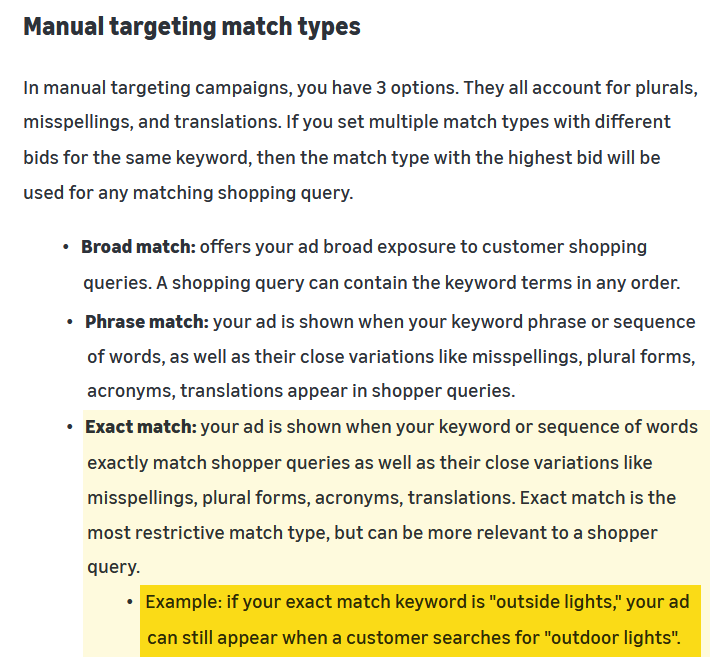
The 7 close variations exact match also buys
Six of these appear on Amazon’s own help and guide pages. The seventh I have not found on any Amazon page, and I have only ever seen it in real search term reports.
| # | Variation | Amazon’s example | Source |
|---|---|---|---|
| 1 | Misspellings | The keyword serves the mistyped query | Understand keyword match types |
| 2 | Acronyms | Short form serves the long form, and back | Understand keyword match types |
| 3 | Translations | The same product word in another language | Understand keyword match types |
| 4 | A different word entirely | “outside lights” serves “outdoor lights” | Understand keyword match types |
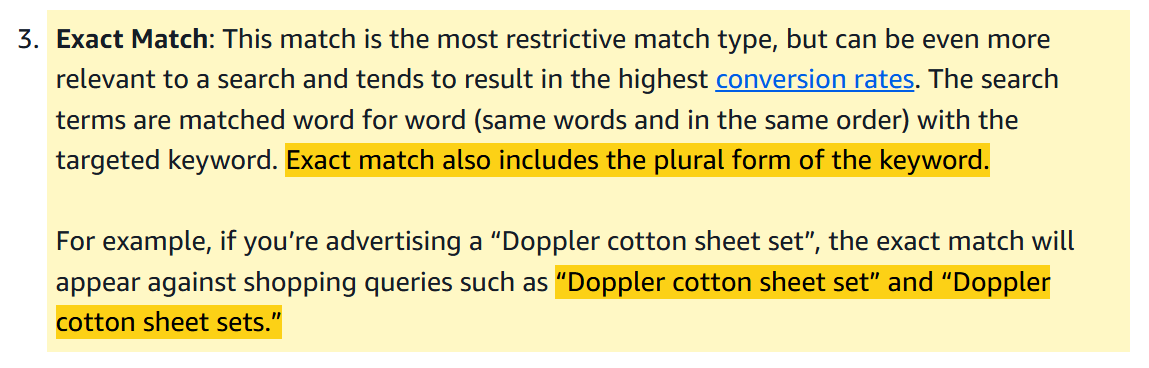
| 5 | Singular and plural | “Doppler cotton sheet set” serves “Doppler cotton sheet sets” | Targeting with Sponsored Products |
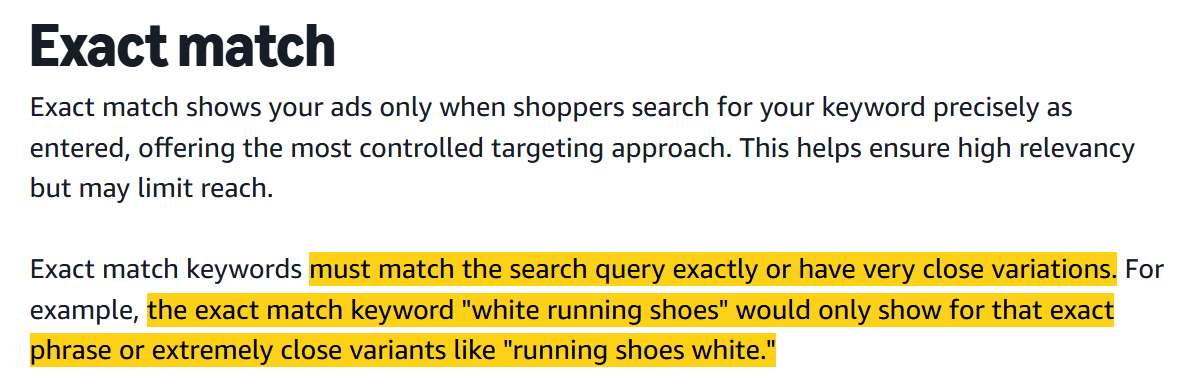
| 6 | Word order | “white running shoes” serves “running shoes white” | Keyword targeting |
| 7 | Stop words added or dropped | See the two report examples below | Our own search term reports |
Number 4 is the one that ends the argument. “Outside” and “outdoor” are not a spelling slip and not a plural. They are two different words, and Amazon publishes that pair as its own example of an exact match.
Amazon contradicts itself on word order
The keyword targeting guide says the exact keyword “white running shoes” can serve “running shoes white”. The Sponsored Products targeting guide says exact match means the same words in the same order. Both pages are live, and both are Amazon’s.
Plan for the wider reading. If you assume word order holds and it does not, the mistake only costs you in one direction.
Stop words, from our own reports
Stop words are the small joining words: of, for, in, the, with. I have not found a stop word example on an Amazon page, but our reports show the matching running both ways.
- Our exact keyword sweets in bulk served the search sweets bulk. The stop word was dropped.
- Our exact keyword gift man served the search gifts for men. A stop word was added, and both words were made plural in the same match.
The second one is two changes at once, which tells you the variations combine. Treat them as a set, not as a list of single steps.
Why this gets expensive: negative exact inherits the same rules
Positive close variations cost you some spend on searches you did not pick. Annoying, survivable, and a bid change fixes it.
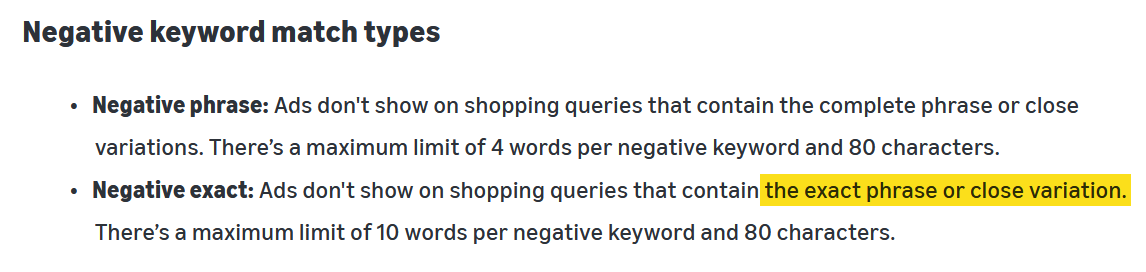
Negative exact is different. The match types page defines negative exact as stopping ads on shopping queries that contain the exact phrase or a close variation. The same wide reading applies. So when you add one negative exact, you are not excluding one row in your report. You are excluding the whole family: the plurals, the misspellings, the stop-word versions, and possibly the different-word versions too.
One of those is often the search that sells.
The worst case is easy to describe. A term with clicks and no sales gets excluded, which is the standard advice and looks perfectly sensible on the row in front of you. The plural version of that term was the profitable one. It stops serving, the sales go, and nothing in the account tells you why, because an excluded query does not appear in the report at all. You cannot see the hole you made.
That asymmetry is the whole reason to treat negatives differently from every other change you make. A paused target comes back tonight. Excluded traffic comes back only if you work out that you excluded it.
The 5-step audit before you add a negative exact
Run this on any term you are about to exclude. It takes about ten minutes by hand for one term.
Step 1. Check relevance first. If the query asks for something your product does not do, exclude it and stop reading. That decision has nothing to do with clicks, and no family total changes it. The rest of this audit is for a relevant term that loses money.
Step 2. Write out the family before you write the negative. For the term you are considering, list every member:
- singular and plural of each word
- each version with and without the stop words (of, for, in, the, with)
- the misspellings you can think of, including a dropped letter and a doubled letter
- any acronym or long form
- the obvious synonym, the outside/outdoor case
- the main words in a different order
Step 3. Total the family, not the row. Pull all of those out of your Sponsored Products search term report and add up clicks, spend and sales across the whole list. That total is what Amazon acts on when your negative goes live. One line on its own tells you very little.
Step 4. Decide from the total. If the family makes money overall, leave it alone. The zero-sales member is part of the cost of the members that sell. If the family loses money overall, the negative is a fair call.
Separate “unprofitable” from “not enough evidence yet” while you are here. Four clicks and no sales is not evidence. Spread across four close variations it is weaker still: four clicks, six, three, five, with one sale somewhere in the group, is a pattern you can only read once the group exists on one line.
Step 5. If you already added it, check backwards. Pull the report for the period before the negative went live, write out the family, and look up each member. Any variation that sold before and stopped after is your damage. Checking forward proves nothing, because the negative removes those queries from the report entirely.
Two time limits bite here. The search term report reaches back about 60 days, and once a day drops out of that window the detail is gone permanently. If the negative is older than that, no data can settle it. Remove the suspect negative, wait two weeks, and watch for sales from a term you were not expecting.
The faster route
Doing step 2 and step 3 by hand is fine for one term. It does not scale to a report with thousands of rows.
The Amazon Exact Match Checker reads your Sponsored Products search term report and shows which of your exact keywords Amazon matched to a different search term, and what each match cost. Your file is processed in the browser and stays on your computer. Use the PPC History Extender first if you need more than 60 days, then the ACoS Calculator on the family total.
When one variation sells and the others do not
This is the most common question, and the honest answer is that there is no split available to you.
An exact keyword on the winner still serves the whole family. A negative on a loser still blocks the winner. So the family stays the decision unit, and your levers are the bid and the price, not the negative. If the waste still irritates you, lower the bid, or lift the profitable variation into its own exact campaign where you control the bid directly. Pausing is reversible. Excluding is not, in any practical sense.
Platform limits worth knowing first
| Limit | What it means for you |
|---|---|
| A negative keyword takes 72 hours to take effect | Checking the report the next morning measures nothing |
| A negative product takes 96 hours | The same trap, a longer wait |
| You cannot change the match type of an existing negative | Remove it, then add it again |
| Negative exact allows 10 words, negative phrase allows 4 | Both cap at 80 characters |
| A negative product at ad group level affects that ad group | At campaign level it affects every ad group in the campaign |
Add a negative product at the level you meant, not the level that was convenient.
FAQ
Is Amazon exact match really exact? No. Amazon’s definition of exact match ends with “close variations”, and its own examples include a plural, a reordered phrase and a different word, “outside lights” serving “outdoor lights”.
Does negative exact only block one search term? No. Amazon defines negative exact as stopping ads on queries that contain the exact phrase or a close variation. One negative exact blocks a family of queries, including plurals and misspellings.
Can I exclude the plural and keep the singular? No. Both sit inside the same close-variation family, so a negative on one reaches the other. Use the bid to control an unprofitable variation instead.
How do I know whether a negative I added last year did damage? If it was more than about 60 days ago, the report data is gone and nothing can prove it. Remove the negative, wait two weeks, and watch for sales from a term you were not expecting.
Does this apply to Sponsored Brands? Amazon’s keyword targeting guide says Sponsored Brands uses semantic, meaning-based matching, which is wider still on the positive side. I have not found an Amazon page that gives a separate negative exact definition for Sponsored Brands, so treat the negative side as at least as wide as Sponsored Products.
What to do next
- Download your Sponsored Products search term report for the last 60 days.
- Run it through the Exact Match Checker and look at what your exact keywords actually bought.
- List every negative exact you added in the last 60 days, and run step 5 on each one.
Then read the negative keywords guide for the wider protocol, and the match types guide for how broad and phrase behave alongside this.