
ACoS Amazon: How To Calculate It & When To Use It
Calculate Amazon ACoS fast with AdRazor's free calculator, then learn what ACoS is, the formula, what a good ACoS looks like and how to improve yours.
Amazon ACoS Calculator
ACoS Meaning and Definition
ACoS stands for “Advertising Cost of Sale”. Amazon reports it for every campaign, ad group and keyword you run. See ACoS Amazon for Amazon’s own description.
ACoS is the ratio of your advertising spend to your advertising revenue from those ads.
It helps you understand the cost of generating sales through your sponsored product campaigns on Amazon. The ACoS meaning and definition are the same whether you’re running Amazon ads, Amazon PPC campaigns, or any other type of sponsored advertising on the platform.
Watch your ACoS to see the profitability and the return on investment of each campaign.
ACoS Calculation and Tools
How do you calculate ACoS? What is the ACoS formula?
To work out a single ACoS figure, use the calculator on this page. Within Amazon’s own advertising console you can see the ACoS of your campaigns, ad groups and keywords, but that console is cumbersome for large volumes of data. You can also download the advertising report spreadsheets from Amazon to see your ACoS data in detail.
Third-party ACoS calculator tools like AdRazor are also available that integrate with your Amazon advertising data. These allow you to calculate ACoS across your entire advertising account. AdRazor offers the most flexible and powerful option of all… introducing traffic light colour-coding so you can easily see which search terms are profitable and which are not, and taking that one step further with a 12-month ACoS history so that you can make all decisions with benefit of context.
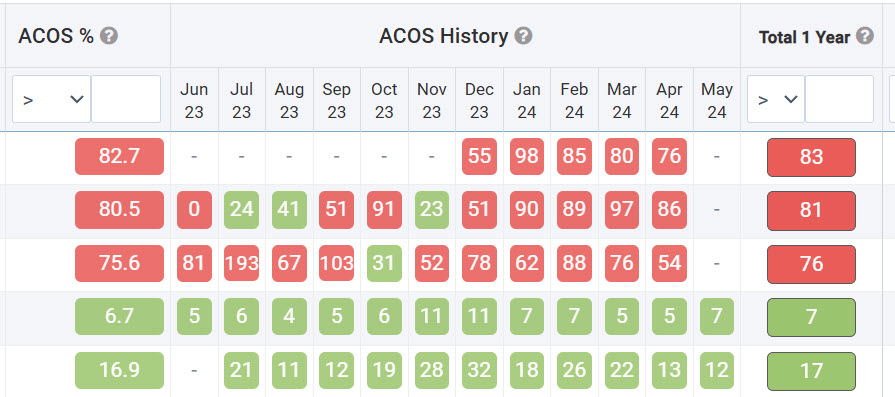
No matter which ACoS calculator you use, the fundamental calculation is the same – your total ad spend divided by your total ad revenue from those campaigns. However, the details of how to calculate ACoS can vary slightly depending on the tool.
For Amazon sellers wanting to calculate their ACoS manually, the calculation is: Total Ad Spend / Total Ad Revenue x 100 = ACoS percentage.
The ACoS formula
ACoS % = 100 × Total ad spendSales from those ads
Use the calculator above for a single figure, and the report spreadsheets when you need to measure a whole account.
ACoS Performance and Metrics
Your ACoS directly impacts key performance metrics for your Amazon advertising campaigns and overall sales. A low ACoS indicates your ads are driving cost-effective sales, while a high ACoS suggests you may be overspending on advertising relative to revenue.
ACoS is closely linked to your overall marketing and advertising performance. Monitoring ACoS alongside sales numbers, impressions and click-through rates gives you a comprehensive view of your campaign’s return on ad spend.
ACoS is also frequently compared against another key metric – RoAS (Return on Advertising Spend). While ACoS shows your ad spend as a percentage of revenue, RoAS flips that ratio to show revenue as a multiple of ad spend. Analysing ACoS and RoAS allows you to evaluate profitability from different angles.
Some sellers also look at ACoS vs TACoS (Total Advertising Cost of Sale), which compares ad spend against total sales, organic sales included. ACoS counts ad-attributed sales only, so TACoS is always the lower figure.
Whichever metrics you prioritise, ACoS measures your advertising efficiency and your profitability on Amazon. Optimising your ACoS directly improves overall sales and marketing performance.
What Is a “Good” ACoS?
When it comes to your ACoS on Amazon, there’s no definitive universal “good” number that applies to all products and businesses. A “good ACoS” can vary significantly based on factors like your profit margins, product prices, competition levels, and overall business goals.
For a detailed analysis of ACoS benchmarks, see our guide on what is a good ACoS on Amazon.
Ultimately, profitability should be the prime consideration rather than focusing solely on ACoS. An advertising campaign with a high ACoS that is still profitable overall is worth running. Any search that generates more revenue than it costs is technically a “good” ACoS, regardless of the percentage, because it is adding to your bottom line.
Profitability hinges on more than just ACoS – it factors in your product costs, margins, average order values, advertising fees, and other expenses. A seemingly high 40% ACoS could still be very profitable for a high-priced item with great margins.
There are also tactical scenarios where accepting a higher ACoS makes sense temporarily, even if it cuts into per-unit profitability:
- Product Launches – When initially launching a new product, you may need to tolerate a higher ACoS to build relevancy, sales velocity, and reviews. This initial investment can pay off longer-term.
- Out of Stock Product – If a hot seller goes out of stock, re-investing in a high ACoS can help regain positioning and momentum once resupplied.
- Improving Organic Rankings – Running campaigns with a higher ACoS can indirectly improve your organic search rankings by driving sales velocity, which Amazon’s algorithm favours.
- Seasonality Positioning – For seasonal products it may be worth accepting a short-term high ACoS ahead of peak demand periods like Christmas, Valentine’s Day and Prime Day, in order to ensure strong positioning and impressions share when shopper traffic spikes.
The key is continuously monitoring ACoS alongside your overall profitability metrics. Optimise for a low sustainable ACoS, but be willing to invest in a higher ACoS strategically when the long-term benefits outweigh the short-term costs.
Amazon ACoS Strategy
Maintaining a healthy and profitable ACoS requires having a well-defined Amazon ACoS strategy in place. An effective ACoS strategy involves several key components:
For comprehensive ACoS optimisation techniques, explore our guides on how to reduce ACoS on Amazon and mastering ACoS optimisation.
- Continuous Monitoring and Optimisation Consistently track your ACoS metrics across all campaigns, ad groups, products, and keywords. Identify areas of inefficiency and optimise accordingly by adjusting bids, reallocating budgets, adding negative keywords, or revising product listings/ad copy.
- Comprehensive Keyword Research Conduct thorough keyword research to uncover relevant high-intent keywords with strong conversion rates. Target these terms precisely through phrase and exact match types to reduce wasted spend on irrelevant searches.
- Strategic Bid Management Implement a data-driven bidding strategy that aligns with your ACoS goals. Use advanced bid optimisation techniques like portfolio bid strategies and placement adjustments to maximise ROI.
- Product Listing Optimisation Ensure your product listings are fully optimised with compelling titles, descriptions, images and enhanced content to increase click-through and conversion rates, which directly impact ACoS .
- Campaign Structure and Segmentation Organise your campaigns thoughtfully by segmenting products, match types, brands/product lines to better control budgets and ACoS at a granular level.
- Automation and Rules Consider leveraging automation rules and scripts to handle routine tasks like bid changes, campaign enabling/pausing to free up time for strategic optimisation.
- ACoS Goals and Benchmarks Set clear yet flexible ACoS targets based on your margins, AOV, and business objectives. Establish benchmarks for “good” and “bad” ACoS to guide decisions.
Implementing a holistic ACoS strategy encompassing these elements allows you to proactively manage and improve your advertising ROI on Amazon over time.
Free Amazon tools
Optimise Your Amazon Sales With Free Tools
Amazon Toolbox
There are a number of tools we wish had existed when we started growing on Amazon.
So we created them for our internal use... and now you can use them too.
Best of all, they're all free.
Get An Unfair Advantage
We're adding more free tools on a regular basis to help you maximise your sales, and more importantly your profits, on Amazon.
To keep updated and get an unfair advantage over your competitors simply share your email address and we'll let you know the instant that we launch the next tool.
Which Tool Would Help You Sell More?
Is there a tool that would really help you but which doesn't currently exist?
If there is then tell us. And if there's enough demand, and we can crowbar the data out of Amazon, we'll create it and tell you when it's done.